
 TR
TR EN
EN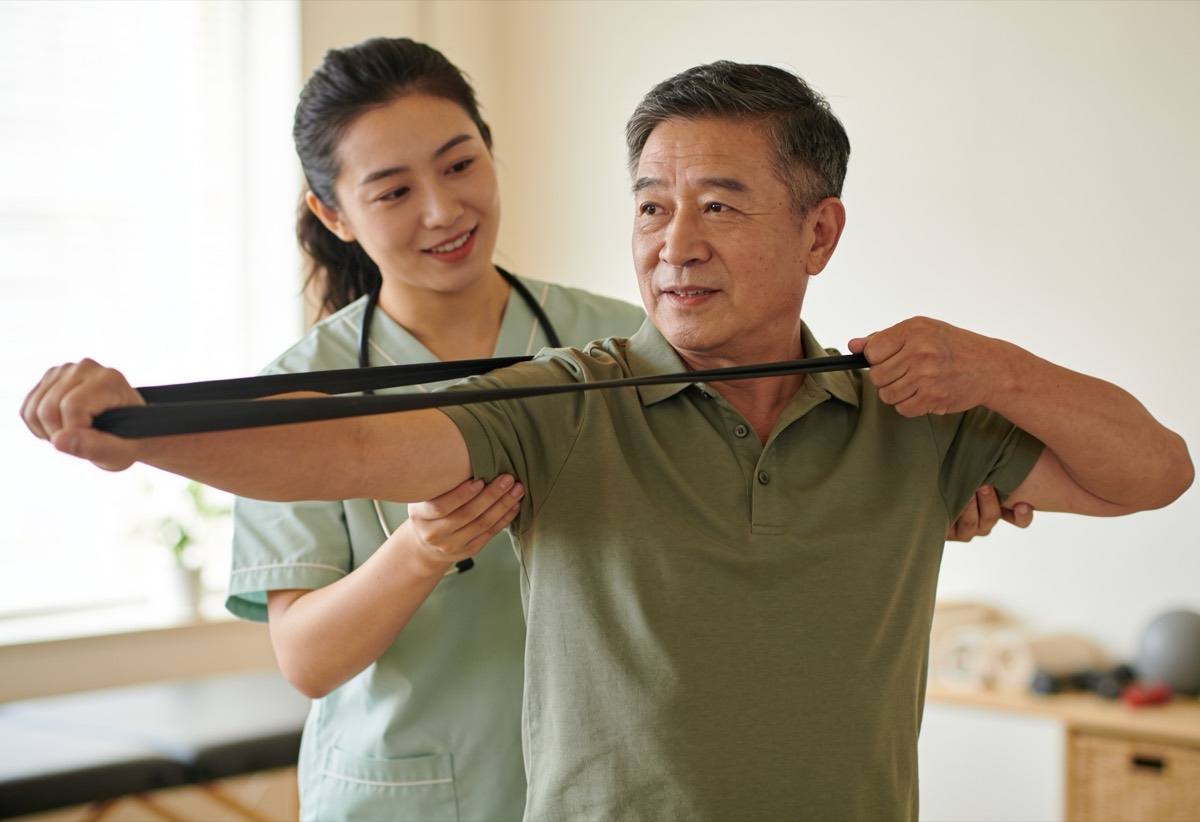
Overview
The rotator cuff consists of the muscles and tendons that hold the head of your upper arm bone (the humerus) in the shoulder capsule. There are four rotator cuff muscles: the supraspinatus, infraspinatus, teres minor, and subscapularis. These muscles help you raise and rotate your arm overhead.
Rotator cuff tears can result from wear and tear caused by everyday use and repetitive overhead arm movements, and they can also occur with a sudden movement in young people and athletes.
Causes
Rotator cuff injuries are a common cause of shoulder pain. Among their causes are;
AGE: As with all muscles, the rotator cuff muscles become more susceptible to injury with advancing age. As one ages, the bone spurs that form on the shoulder bones can also cause tears in the muscles.
REPETITIVE MOVEMENT: Rotator cuff tears occur in jobs that require repetitive movements, especially those requiring you to raise your arm overhead. For example, they are seen more frequently in occupational groups such as painters and carpenters, and in people engaged in sports such as baseball, tennis, rowing, and weightlifting.
TRAUMATIC TEARS: If you fall onto your outstretched arm or lift something very heavy with a sudden movement, a tear can occur in the rotator cuff muscles.
Symptoms
- The most common symptoms of rotator cuff tears are:
- Pain at rest and at night, especially when lying on the affected shoulder
- Pain when raising and lowering your arm, especially in movements that require us to raise the arm overhead
- Muscle weakness felt when raising and rotating your arm
- Crackling or clicking sounds heard during shoulder movements
- Limitation in shoulder movements
Diagnosis
Rotator cuff tears can be partial or full-thickness tears. While partial tears respond well to non-surgical methods, full tears may require surgery. A detailed examination is needed for this.
If any of the findings mentioned above are present, a doctor should be consulted without delay. For diagnosis, your complaints, the history of how the condition developed, and a detailed physical examination are sufficient for preliminary information.
X-ray is used to see the possibility that bone spurs are causing the rotator cuff tears.
MRI shows soft tissues such as the rotator cuff tendons better. In addition to the rotator cuff tear, it is also possible to determine the location and size of the tear with this method.
Treatment
Rotator cuff tears can grow over time if left untreated despite the pain. For this reason, an appropriate treatment method should be tried without delay. Age, activity level, general health, and the size of the tear are important in the decision for treatment or surgery. There is no evidence showing that surgery performed close to the time of injury gives better results than surgical interventions performed later. For these reasons, many doctors recommend treating rotator cuff tears first with physical therapy and other non-surgical treatments.
In approximately 80% of patients, treatment methods other than surgery relieve pain and improve function in the shoulder.
The non-surgical treatment options are as follows:
Rest: In tears that develop due to incomplete and repetitive use, rest can help reduce complaints. A shoulder sling may also be recommended during this period to help protect and immobilize your shoulder.
Activity modification: Avoiding activities that cause shoulder pain can help reduce complaints and speed the recovery process.
Nonsteroidal anti-inflammatory drugs and steroid injections
Strengthening exercises and physical therapy: Specific movements help restore shoulder movements and strengthen the shoulder. By including stretching movements in the exercise program, limitation of movement can be eliminated. The heat and cold agents used in physical therapy can reduce pain complaints.
What We Do
First, our doctor performs a detailed physical examination on our client who comes with a shoulder complaint. For a patient who does not need surgery, a physical therapy program is prescribed.
Dry needling is a method that involves inserting needles, without medication or injection, into the trigger points where pain and tension are identified in the muscles. Recent studies show that, in rotator cuff tears with pain complaints and limitation of shoulder movement, dry needling applied to this area reduces pain complaints, softens the tense muscles, and consequently improves shoulder limitation. For this reason, our doctor applies dry needling (acupuncture) treatment to open up the joint limitation in the shoulder and reduce pain complaints.
At the start of the session, we perform a brief application with heat and cold agents, which are among the physical therapy modalities. The aim is to use the effect of these agents on circulation to reduce pain complaints and, in cases with edema, to reduce the edema.
Mobilization application — encompasses the entirety of movements applied to the joints repetitively, at low speed and variable intensity, so that the joints relax and reach their normal range of motion. When these movements are applied appropriately, they reduce pain and relax tense muscles. For this reason, in rotator cuff syndrome our physiotherapist performs mobilization applications on the patient.
With appropriate stretching and strengthening exercises, we provide strengthening under the physiotherapist's supervision in a way that does not cause pain. By increasing the duration and intensity of the movements under the physiotherapist's supervision, we prevent further damage to the shoulder. In the final stage, by thoroughly strengthening the muscles, we aim for a pain-free and fully open range of shoulder motion.
Kinesiological taping is a method actively used by athletes. It is a method used in painful conditions or injuries to provide support and stability to the muscle along its axis. The role of the rotator cuff muscles is to hold the head of the shoulder stable in its socket and to participate in overhead movements. In rotator cuff injuries, athletic taping applied to the muscle with the correct technique reduces the load on the muscle and provides stabilization. In this way, it speeds up the muscle's recovery process. We too end our sessions with athletic taping. In this way, by reducing the extra load on the muscle during the times outside the treatment hour, we support the recovery process and prevent the damage from growing.
With our entirely manual-therapy-focused approach, we provide maximum benefit and achieve a faster and higher-quality recovery.